
I was flicking through YouTube yesterday, looking at videos I had added to my favourites over the years, when I remembered one that was notable by its absence. Sometime around 2008, I’d stumbled across a video that blew my mind and the memory of it was so intriguing that I went in search of it again. It concerned an incident that happened on the M6 motorway involving two Swedish sisters. That was all I could remember of it but it was enough. I searched for “swedish sisters motorway mystery” and there it was.
This is a video with footage that would probably be labelled as fake or AI-generated if it were distributed today. I would be fairly sure that there were some people who doubted it’s realness 18 years ago. I can’t remember how the video first came to my attention but in 2008, the web still had a lot of power to surprise people.
If you don’t already know the case of the Eriksson sisters, I would recommend that you first watch the episode of Motorway Cops on YouTube first before reading more about the case. That way you can fully experience the shock of the encounter from the perspective of the highway police who just happened to be being filmed by a documentary crew on the day. What follows from here is my own thoughts and commentary on this so… spoiler alert. Go watch it first.
Madness on the M6
Firstly, let’s just cover context and the effect it creates on the viewer. I find it hard to believe that this was actually broadcast during prime time on the BBC but that is probably what makes it so uncanny. Motorway Cops is one of those shows that is “background telly”, something you watch because you don’t want to think or because there is nothing else on. By 2008, this genre was pretty well established (and widely parodied) so viewers would know what to expect. Everyday incidents where the tension is heightened by the use of fast-paced editing and dramatic music to squeeze every last drop of story from the footage.
When you see the CCTV footage of the two women walking down the central reservation, it’s unusual but familiar enough given the genre. The ease with which one of the women crosses the barrier into traffic and is immediately struck by a car is quite alarming to see but no more so than any similar incident we are used to seeing captured on in grainy, stuttering monochrome. The behaviour is odd but is passes by too quickly to really register as the drama moves to the call centre and the talking heads of the responding officers. With hindsight though, you can see this as the first indication of the madness of the events that follow.
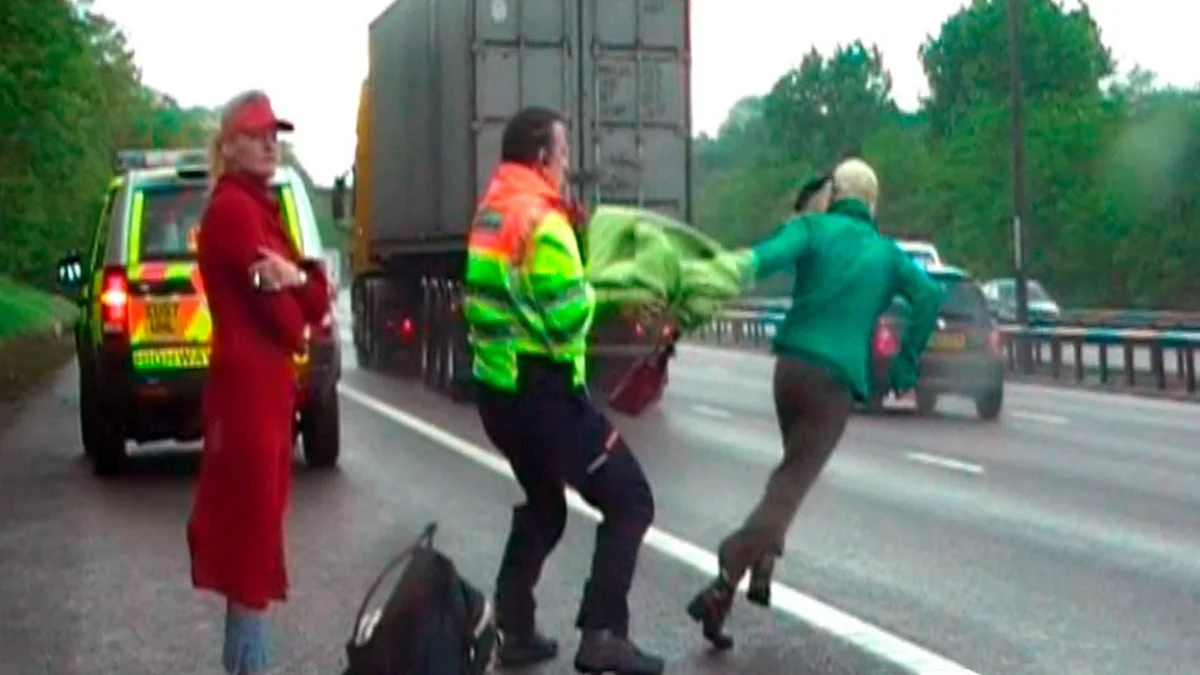
When the two police officers responding to the call pull up on the hard shoulder of the M6 with the TV documentary crew nothing seems that wrong at first, other than the fact the neither of them looks like they have just been struck by a car. They are standing there on the hard shoulder, casually smoking whilst a highways officer stands between them and the motorway traffic a few metres away. Now, I don’t know if you have ever spent any time on the hard shoulder of a UK motorway but the one thing that becomes immediately apparent is how fast the vehicles are travelling once you are stationary. That’s why nowadays the advice is to leave your vehicle if broken down and get as far away from the carriageway as possible. I would definitely not be as cool and collected as the two Swedish women appear.
As the police officers Tracy Cope and Paul Finlayson step out of their car to approach the two women and the highway officer, all hell breaks loose. One of the women, who we later learn is called Ursula, attempts to step out into the motorway. The highways officer grabs her jacket but she slips loose of it into the path of a truck travelling at almost 60 miles an hour. We are spared from witnessing the exact moment of impact as the documentary camera’s view is obscured by the head of a police officer’s head. It’s almost like he saves us from seeing it. But you hear his disbelieving voice - “Oh my god!”
As soon as Ursula's body lies still on the tarmac, her sister Sabrina also steps into traffic and is struck by a car for the second time, this time being knocked unconscious. The entire episode unfolds in seconds that leave both the police and witnesses shocked as the documentary footage from the TV show goes on to show. The sisters emerge remarkably unscathed from what should have been a fatal encounter, only to carry on behaving madly, fighting off the police and medics that come to their aid.
And the story only gets stranger and more tragic even after everything that transpires on the motorway. You can read the rest of it in the Wikipedia entry dedicated to Ursula and Sabina Eriksson. The eventual diagnosis for their behaviour was folie à deux or “madness of two”, a rare psychiatric disorder where a delusion is passed from one person to another. This delusion was the reason for them stepping out in front of the motorway traffic as they seemed not to believe in the reality of their surrounding, Sabrina saying to the police officers at one point “I know you’re not real”. The road safety procedures didn’t fail the sisters as much as their own minds did.
Memory of a misstep
I was struck by a car once. The memory of it now seems strange, like it happened to someone else. I know that it was real but perhaps for psychological reasons, my recollection is distant and unemotional, a Zapruder film that plays in my mind, with jump cuts and reels missing.
When I was about 14 years old, I took over a friend’s paper round to earn some pocket money during the summer holidays. On my first day delivering papers, within the first 30min, I stepped out onto the road that ran through the small town I lived in. And then everything goes blank. I have no memory of seeing the car or being struck by it. Apparently I was sent flying. The driver wouldn’t have been travelling that fast but maybe a little too fast for the residential street I was struck on. It may have been entirely my fault for forgetting The Green Cross Code and the lesson of Tufty Fluffytail as every child of my generation was taught. These stories kept us safe by making us aware of the danger of roads and car but maintaining the fiction, that provided we followed the rules, no harm would come to us.
I was in and out of consciousness during the trip to the hospital. My eyes closed as everything was a blanket of darkness but I felt every bump in the road. I was lucky as the only damage was whiplash. I spent an uncomfortable night in traction and they discharged me with a neck brace the next day. There was no lasting damage, other than some occasional cramps I would get that felt like they were coming from my head, an after effect of the whiplash no doubt, but no one else I knew seemed to experience them. The lack of memory tickled my mind, a missing splash of consciousness that meant that I could never re-experience the moment, just like Paul Finlayson’s head blocking my view.
Failure of fiction
I was a big fan of science fiction when I was younger, following a path from Ray Bradbury to Philip K. Dick and then J. G. Ballard. Ballard was of course a chronicler of inner space as much as outer space, and the psychological effects of modernity and it’s materialisation, amongst them the automobile and the culture it created as mass ownership took hold during the 1960s. As the author of Crash, Ballard had already used the car as a total metaphor for life. Ballard spent most of his own life within sight of the M4 and Heathrow, found in the car not simply a fetish object but the perfect example of a modern fiction that everyone performs without question.
Civilised life is based on a huge number of illusions in which we all collaborate willingly. The trouble is, we forget after a while that they are illusions and we are deeply shocked when reality is torn down around us
J. G Ballard
In Concrete Island, a man crashes his car onto a traffic island at the junction of three motorways and finds himself unable to attract the attention of a single passing driver, trapped in full view of thousands of people, none of whom see him. It's the uncanny normalcy of the world laid bare, that the ordinary surface conceals an inhuman indifference just metres, or a short psychological push, from where we stand.
I would have loved to know what Ballard might have made of the Eriksson sisters. The M6 incident took place less than a year before his death, like a small prophecy fullfilled. The documentary film crew and police offers carry out their normal duties on a Saturday morning feel like exactly the kind of preface to shocking violence that he might have penned. Even my paper round is one of those details that you would routinely use to emphasise just what an ordinary day it was.
It's kind of crazy, really, that we suspend our disbelief every day, that all these destructive machines around us aren't simply metres and moments away from colliding with our frail bodies, with only a thin wall of sanity or rules to protect us that we dare not step outside of.